Most small businesses do not have a branding problem because they made bad choices. They have one because nobody ever wrote the rules down. Every new flyer, post, invoice, and website gets made from scratch, by whoever is available, in whatever tool is open. The result looks like several different companies.
The thing missing in almost every case is a Brand DNA.
This piece is a plain explanation of what a Brand DNA is, what it contains, how to write one for your own business, and what actually changes once you do. No jargon, no three-day workshop, no $8,000 agency invoice.
The short definition
A Brand DNA is a written document that captures the strategic foundation of your brand. It states what you stand for, who you are talking to, how you want to sound, and what makes you different. Every other piece of your brand reads from it: the logo, the colours, the website, the posts, the business card.
It is not a logo. It is not a colour palette. It is not a style guide. Those are outputs. A Brand DNA is the input that makes those outputs coherent.
If you have ever wondered why a competitor’s social posts, website, and packaging all feel like they came from one place while yours feel like four, the answer is almost always this: they have written their Brand DNA down, and you have not.
What a Brand DNA contains
A proper Brand DNA has five parts. Every item below is one that you can write in a sentence or two. Together they take about a page.
1. Positioning
One sentence that says what you do, for whom, and why it matters. Not what you sell. The claim you make on your category.
Weak: “We sell high-quality coffee beans.”
Strong: “Coffee for people who take their craft seriously.”
The weak version describes a product. The strong version takes a side, implies an audience, and gives every downstream decision a filter to pass through.
2. Audience
Who this brand is for, written as the actual people rather than a demographic bracket. “Men 25 to 44 with disposable income” is a census category. “Independent designers and writers who work from a desk in the morning” is a person you can picture.
The test is whether you could identify a real customer when you met one. If your audience description applies to a third of the population, it is not an audience description. It is a filter that stopped working.
3. Personality
Three to five adjectives that describe how your brand behaves. These are not words you say to your customer. They are words that govern how you say everything else.
Useful examples: considered, warm, confident, editorial, unfussy, precise, playful, dry.
Useless examples: innovative, premium, unique, best in class. These are claims every brand makes about itself and none of them tell a copywriter or designer anything useful.
4. Tone of voice
How the personality shows up in writing. One or two short sentences that a copywriter could read and immediately pitch five headlines in.
Example: “Editorial. Direct. Never precious. Short sentences. Specific nouns.”
You will know this one works when a new piece of copy either passes it or fails it on reading. If every piece passes, the tone is too loose. If nothing passes, it is too narrow.
5. Reference language
A short list of words and phrases that belong to the brand, and a shorter list of words the brand never uses. “Single-origin” is in. “Journey” and “elevate” are out. This is the part that keeps the voice stable across different writers and different weeks.
Why most small businesses do not have one
Three reasons recur.
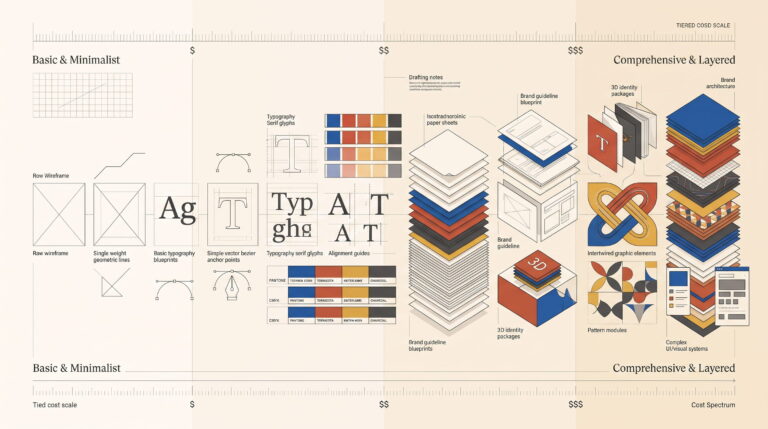
The first is cost. Writing a Brand DNA has historically been something you buy from an agency. A proper identity workshop produces this document, usually bundled with a logo and style guide, and the invoice runs from $5,000 at the very low end to $50,000 at the mid-market end. A sole trader launching a business cannot absorb that cost, so they skip the step and go straight to designing a logo. The logo looks fine, but it has nothing underneath it, so every subsequent asset starts from zero.
The second is that it feels optional. You can start a business, take payments, and serve customers without ever writing a Brand DNA. Nothing visibly breaks. What happens instead is that the brand quietly fails to compound. Every new piece of marketing is a fresh decision rather than a build on what came before, so none of it adds up.
The third is that most small business owners do not know this document exists as a thing you can write. They have heard of brand guidelines (the output). They have not heard of a Brand DNA (the input). So they skip the hour that would have saved them a year.
What changes once you have one
Five things happen the week after a Brand DNA is in place.
Decisions get faster. You no longer debate every colour, every headline, every social post. The DNA either approves it or it doesn’t. The time you used to spend second-guessing yourself goes back into the actual work.
Delegation becomes possible. A VA, a freelance designer, a copywriter you hired on Upwork, any of them can produce on-brand work from a one-page document. Without it, you are the brand, and everything has to go through you.
Ready to create your own brand?
Create Your Own BrandMarketing starts compounding. This week’s Instagram post builds on last week’s because they share a palette, a voice, and a positioning. The audience learns what you look like. The audience that is going to buy from you starts to recognise you across platforms.
The brand survives rewrites. When you redesign your website, launch a new product line, or change social platforms, the DNA travels with you. The visual expression updates. The underlying brand does not drift.
Pricing conversations get easier. A brand with a written foundation reads as more established, which translates directly into what you can charge. This is unglamorous but true: the same service, offered by a brand that feels thought-through, commands a higher price.
How to write your own Brand DNA in an afternoon
You do not need an agency to write this. You need an afternoon, honest answers to five questions, and the discipline to put it in writing instead of leaving it in your head.
Open a blank document. Write the five section headings from earlier in this piece. Then, section by section, answer the following.
For positioning: finish the sentence “We make X for Y who want Z”. Write it ten times, each time trying to be more specific than the last. Keep the version that feels truest, not the one that sounds most impressive.
For audience: name one real person who is already your best customer. Describe them in three sentences. What they do, what they care about, what they already use. If you do not have a best customer yet, describe the person you most want to serve. The specific one, not the composite.
For personality: write ten adjectives that describe how you want the brand to feel. Cross out any that would also describe a cereal brand, a bank, or a consulting firm. From what remains, keep three to five.
For tone of voice: write one paragraph in the voice you want the brand to use. Then write what the voice is not. (“Not cute. Not corporate. Not aspirational.”) Keep the shortest version of both that still says what it needs to say.
For reference language: list ten words the brand would use. List five it would never use. Add to both lists over time.
Save the document. Put it somewhere you can get to in two clicks. That is your Brand DNA.
How to use it once you have it
A Brand DNA that lives in a folder you never open is a Brand DNA you do not have. Four practices make the difference.
Open it before you make anything. New Instagram post, new email, new landing page, new headline on an ad. Thirty seconds of re-reading the DNA before you start saves an hour of second-guessing while you work.
Pass every output through it. After you draft something, read the DNA, read the draft, and ask whether they match. If they do not, the draft is wrong. If they do, publish.
Share it with anyone who makes something for you. A designer, a copywriter, a VA, a developer, a printer. Everyone who touches the brand should have the document.
Update it when the business changes. Not every month. But when your positioning actually shifts (new audience, new category, new price tier), rewrite the sections that have moved. The DNA is a living document, not a tablet.
Common mistakes
Three to watch out for.
Writing it like a brochure. This document is for you and the people who work on your brand, not for your customers. Nothing in it needs to sound polished. It needs to be true and specific. If a line sounds like something you would put on a landing page, rewrite it.
Trying to appeal to everyone. A good Brand DNA excludes people. If your audience section describes 80% of consumers, it is useless. The point of writing it down is to make trade-offs explicit, so you can stop trying to serve people you were never going to convert.
Confusing the DNA with the visual identity. The logo is not the brand. The colour palette is not the brand. These are expressions of the brand. The DNA sits upstream of both. If your logo changes, the DNA should not need to. If the DNA changes, the logo probably does.
Where this fits with everything else
A Brand DNA is the first step, not the last. Once it is written, everything downstream becomes easier to produce because every piece has a reference to check against. Your logo gets designed from it. Your brand assets library organises against it. Your website, your social posts, your print assets all pull from the same source.
That is why consistency stops being something you have to police. It becomes a product of the system rather than a result of discipline.
If you want this done for you
The Brand Strategy and DNA module on Text to Brand writes this document from a one-paragraph description of your business. Every section (positioning, audience, personality, tone of voice, reference language) is generated against your brief, editable in the same interface, and read by every other module on the platform when it generates a logo, a website, a social post, or a print asset.
The output is the same five-part document described in this piece. The difference is that it takes two minutes instead of an afternoon, and the rest of your brand gets built from it immediately.
Describe your business and see what comes out. Free to try, no card required.