There is a wide answer and a narrow answer. The wide answer, which is accurate, is between $0 and $200,000. The narrow answer, which is more useful, depends on what you actually need, how much of it you want to do yourself, and whether you are buying a logo or a brand.
This piece walks through the real price ranges for small business branding in 2026, what each tier delivers, what it leaves out, and the hidden costs that no quote mentions upfront. No pitch, no fake urgency. Just numbers and context so you can decide where your budget lands.
What you are actually paying for
Before any price, worth being clear about what the money is buying. A professional brand purchase breaks into four things:
- Strategy, which is the written foundation (positioning, audience, personality, tone of voice). This is the Brand DNA.
- Identity, which is the visible expression: logo, colour palette, typography, basic rules.
- Assets, which are the applied pieces: business cards, social templates, website, email signature, slide deck, print.
- Ongoing production, which is the stream of posts, pages, ads, and print that comes out of the brand each month.
Most pricing confusion comes from treating these as one thing. A $400 logo is cheap. A $400 full brand is impossible. Keep the four categories separate as you read.
The real price tiers in 2026
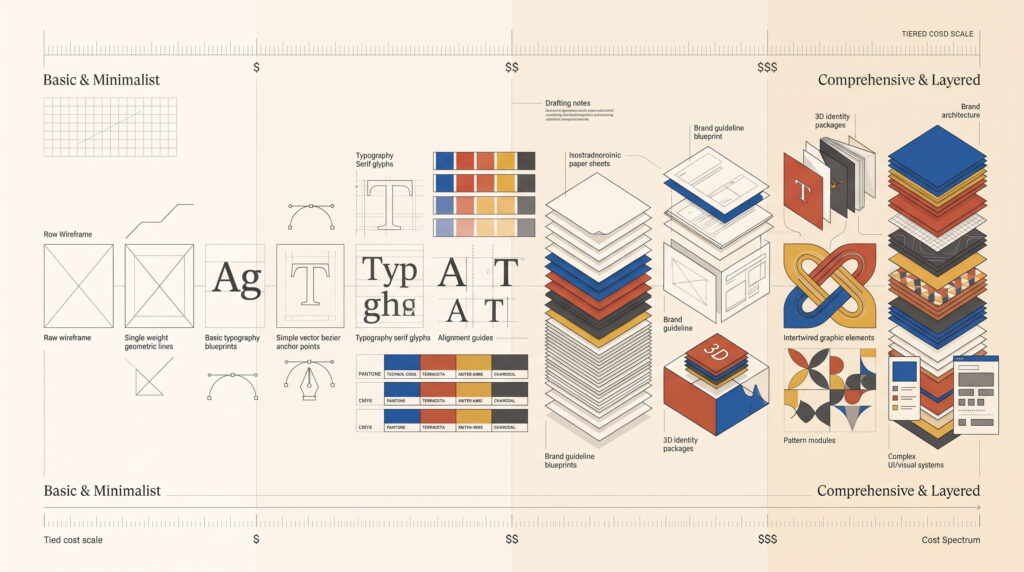
Five routes, each with a real range, what you get, and what breaks.
Tier 1: DIY tools (free to $500 one-time)
Canva, Logo Maker apps, Hatchful, free online generators. You produce the files yourself using templates.
What you get: A logo you drew in a web app, usually as a PNG. Some tools throw in colour and type suggestions. If you pay for Canva Pro ($120 per year), you get templates to apply the logo across social posts.
What breaks: No strategy. No vector files (so your logo pixelates on anything printed above the size of a business card). No consistency between the logo and the rest of your marketing. Thousands of other businesses pick the same template, so your brand looks like theirs.
When this is the right choice: You are testing an idea, you need a placeholder for the next six months, and you are the only person who will ever use the files.
Tier 2: Marketplace freelance ($50 to $800)
Fiverr, Upwork, 99designs contests, Dribbble freelancers at entry rates.
What you get: A logo designed by a human, usually delivered as SVG and PNG. Three to five rounds of revisions on most packages. On the higher end of this range, a small set of applications (business card, letterhead, basic social templates).
What breaks: Quality varies wildly inside this range. The same $300 budget can produce excellent work from a mid-career designer who happens to be building a portfolio, or a template rework from someone who delivers 50 logos a week. There is no strategic work included: the designer executes what you brief, so if your brief is weak, the output is weak. Ownership gets murky because designers at this tier sometimes reuse elements across clients.
When this is the right choice: You have a clear idea of what you want, you have time to vet portfolios properly, and you are buying a logo rather than a brand.
Tier 3: Independent freelancer or boutique designer ($1,500 to $8,000)
A mid-career independent designer, usually with 5 to 15 years of experience, often found via referral or a design-focused community.
What you get: A proper discovery conversation. A written strategy (or at least a positioning direction). A logo system (primary, secondary, icon, monochrome). A colour palette with HEX, RGB, and CMYK values. A type system. A basic style guide. On the higher end, a set of applications: cards, social templates, maybe a landing page.
What breaks: Timelines are long because the designer is one person. Four to eight weeks is typical, which can be a problem if you are launching soon. Ongoing production is not included, so you still need someone (or something) to make the Instagram posts after the identity is delivered.
When this is the right choice: You can afford to wait, you want human creative judgement in the result, and you expect to keep working with the designer for ad-hoc projects.
Tier 4: Boutique studio ($8,000 to $30,000)
A design studio with three to ten people, usually with a specialism (hospitality branding, DTC product brands, SaaS brands, local independents).
What you get: Full brand strategy document. Research. Audience work. Logo system. Comprehensive identity with multiple applications. A proper brand guidelines document. Launch assets. Sometimes a website, often sold separately. Usually a presentation session where the studio walks you through why they made each decision.
What breaks: The timeline grows further. Six to twelve weeks is normal. The scope creeps because studios bill by hour or project, so changes mid-project cost extra. The output can feel over-polished for a small business, especially when the studio applies the same brand-of-the-year visual language to every client in a quarter.
When this is the right choice: You are raising capital, launching with a visible marketing push, and need every asset to be considered. The brand is a serious operating lever rather than a cost line.
Tier 5: Full-service agency ($30,000 to $200,000+)
A branding agency with twenty or more staff, often with international offices, usually working with mid-market or enterprise clients.
What you get: Everything in tier 4, plus market research with real respondents, qualitative audience work, competitive analysis, naming (if needed), trademark search, a full identity system across every conceivable application, extensive guidelines document (often 60 to 120 pages), launch campaign, and typically a six to twelve month engagement with ongoing support.
What breaks: Timelines run three to nine months. The small-business owner has no business being here. These agencies are built to serve clients with annual marketing budgets above $500,000.
When this is the right choice: You are the CMO of a mid-sized or enterprise company with a seven-figure brand budget. If that is not you, this tier is not for you.
Ready to create your own brand?
Create Your Own BrandWhat drives the cost
Five factors move a quote inside and across these tiers.
Hours. The single biggest input. A boutique studio charging $12,000 for a brand is quoting roughly 80 to 120 hours of senior and junior time. An agency at $80,000 is quoting 400 to 600 hours. You are paying for people’s time at $100 to $300 an hour, loaded for overhead.
Research depth. Running focus groups, surveys, or stakeholder interviews adds $3,000 to $20,000 depending on scope. Most small-business brands do not need this. Enterprises often require it before they will approve a brand.
Deliverable scope. A logo alone is cheap. A logo plus a website plus packaging plus a brand book plus a launch campaign is not. Every added application compounds.
Revisions. Low-tier contracts cap revisions at two or three rounds. Higher tiers include unlimited revisions inside the project scope. The cost of exceeding caps at the lower tiers often brings the total up into the next tier anyway.
Ownership of the files. Some contracts hand you the final files but keep the source files. If you ever want to adjust the logo yourself, you have to come back to the designer. Check this before signing, not after.
Hidden costs nobody mentions upfront
Four that come up afterwards and that budgets rarely include.
Font licenses. If the designer picks a commercial typeface, the license is on you, not them. A proper web and desktop license for a mid-tier typeface runs $100 to $800 per year. Enterprise typefaces run into the thousands.
Stock imagery. If your identity uses photography and nobody shot it originally, you are either paying for licensed stock ($50 to $500 per image) or commissioning a photographer ($1,500 to $8,000 per shoot).
Website development. Branding studios often sell the brand but subcontract the website or exclude it entirely. A branded website done properly adds $4,000 to $40,000 depending on complexity.
Ongoing production. The brand is a one-off cost. The social posts, print runs, ad creative, email templates, and seasonal campaigns that come out of it afterwards are not. A small business doing social properly spends $500 to $3,000 per month on ongoing creative production. That is a line item that does not appear in a branding quote.
A simple decision framework
Four questions, in order. Answer them honestly and the tier mostly picks itself.
- How long until you need this live? Under two weeks: tier 1 or 2. Two to six weeks: tier 2 or 3. Six weeks to three months: tier 3 or 4. Three months or more: tier 4 or 5.
- What is the brand’s role in the business? A placeholder while you test an idea: tier 1 or 2. A credible face for client-facing work: tier 2 or 3. A core lever for growth: tier 3 or 4. A strategic business asset: tier 4 or 5.
- How much ongoing production do you need? Low (website and a few posts): tier 1 to 3 handle this. High (daily content, multiple campaigns, multi-channel): the branding tier matters less than the production system you set up alongside it.
- Who is going to use the files after delivery? Just you: lower tiers work. You plus a VA plus a freelancer plus a printer: you need a brand guidelines document, which starts to appear reliably at tier 3.
Nothing in this framework says “pick the most expensive you can afford”. Spending more does not guarantee a better brand. Spending in the wrong place guarantees a slower one.
Where AI brand builders fit in
AI brand builders have appeared as a sixth tier that sits mostly between tier 1 and tier 3, and they change the calculation enough to warrant their own section.
What they cost: $20 to $150 per month, usually month-to-month rather than one-off. Annualised, that is $240 to $1,800 per year.
What they produce: A written strategy document, a logo system in vector format, a colour palette, type pairing, a website, social templates, and brand asset storage. The scope is roughly what you would get at tier 3, delivered in minutes rather than weeks.
What breaks: The output is only as good as the input you give it, and the result is a strong first draft rather than a polished final. Most of these tools expect you to review, edit, and refine. If you want someone else to make every decision for you, this tier is not for you. If you are willing to spend an afternoon directing the output, you can land somewhere between tier 2 and tier 3 at a fraction of the cost.
Where this changes the math: For a solopreneur or small business that would previously have had to choose between a $300 Fiverr logo and a $6,000 freelance brand, there is now a middle option that delivers more than the first and costs less than a hundredth of the second. For agencies, the same tools compress the production time on first-round work from weeks to hours, which changes the economics of taking on smaller clients at all.
Honest limits: AI brand builders will not replace a studio for a flagship brand launch, and they do not include the human strategic judgement that makes a $20,000 studio engagement worth paying for. What they do is make a competent, consistent brand affordable for every business that previously had to settle for a Fiverr logo and a Canva template library.
The honest answer, in one sentence per tier
- Testing an idea: free to $500, DIY tools
- Need a logo this week: $200 to $800, marketplace freelance
- Building a real small business: $20 to $150 per month, AI brand builder, or $1,500 to $8,000 one-off with a freelance designer
- Launching with intent: $8,000 to $30,000, boutique studio
- Mid-market or enterprise: $30,000+, full-service agency
Most small businesses sit in the third tier and have historically felt priced out of it. That is the gap AI brand builders have closed.
If you want to see what the AI tier produces
The Text to Brand demo takes a one-paragraph description of your business and produces the full tier-3 scope (strategy document, logo system, website, social kit, brand assets library) in about three minutes. Free to try, no card required, and you can see the actual output before deciding whether to subscribe.
Plans start at $29 per month on the Launch plan, which includes 1,000 monthly credits (enough for a complete brand build and ongoing content), vector exports on everything, and no watermarks. If it is not for you, cancel and keep every file you have already exported.
Whichever tier you end up choosing, the useful shift is realising you have five real options rather than two. The right one depends on where you are, not on what sounds most impressive.